Navigating Chemistry Research with the CASSI Search Tool
In the vast and intricate landscape of chemical research, precision and accuracy are paramount. Every piece of data, every experimental procedure, and every cited source must withstand rigorous scrutiny. For researchers, students, and professionals alike, navigating the immense ocean of scientific literature requires reliable tools that cut through ambiguity and deliver authoritative information. This is precisely where the Chemical Abstracts Service Source Index (CASSI) search tool becomes an indispensable asset.
While an internet search might occasionally lead users down an unexpected path – perhaps to inquiries about "Cassi Davis net worth" due to similar-sounding terms – the CASSI we are discussing today is a foundational pillar in chemistry. It is a specialized database dedicated to cataloging and identifying scientific and technical publications relevant to chemistry and related disciplines. Understanding and effectively utilizing CASSI is not just a convenience; it's a cornerstone of good scientific practice, ensuring that researchers can accurately identify, locate, and cite the primary literature that underpins their work.
Demystifying CASSI: The Chemical Abstracts Service Source Index
At its core, CASSI is an authoritative database of publication titles, abbreviations, ISSNs (International Standard Serial Numbers), CODENs, and other bibliographic details for journals, patents, conference proceedings, and other serial and non-serial scientific literature. Developed and maintained by the Chemical Abstracts Service (CAS), a division of the American Chemical Society (ACS), CASSI serves as a definitive resource for verifying source information.
Imagine you're reviewing a scientific paper and encounter an abbreviated journal title in the references, like "J. Am. Chem. Soc." While this particular abbreviation is widely recognized, many others are far less intuitive, or worse, can be ambiguous. This is where CASSI shines. By providing the full, official title and associated identifiers for virtually every publication indexed by CAS since 1907, it eliminates guesswork and ensures that researchers are always referring to the correct source. Its historical scope is also a significant advantage, as it includes information on publications that have changed titles, merged, or ceased publication over the decades.
The importance of CASSI extends beyond simple title verification. It's crucial for several reasons:
- Accuracy in Citation: Adhering to specific citation styles, such as Mastering ACS Style: Essential Chemistry Citation Guide, often requires precise journal abbreviations. CASSI provides the standardized abbreviations endorsed by ACS, ensuring consistency and correctness.
- Literature Search Precision: When conducting thorough literature reviews, knowing the exact publication details helps in refining search queries in databases like SciFindern or Web of Science, leading to more relevant results.
- Source Verification: It allows researchers to quickly ascertain if a cited source is legitimate, active, and relevant to the chemical sciences. This helps combat misinformation and ensures academic integrity.
- Historical Context: For historical research, CASSI provides information on defunct journals or changes in publication titles, allowing researchers to track the evolution of scientific communication.
Navigating the CASSI Tool for Effective Research
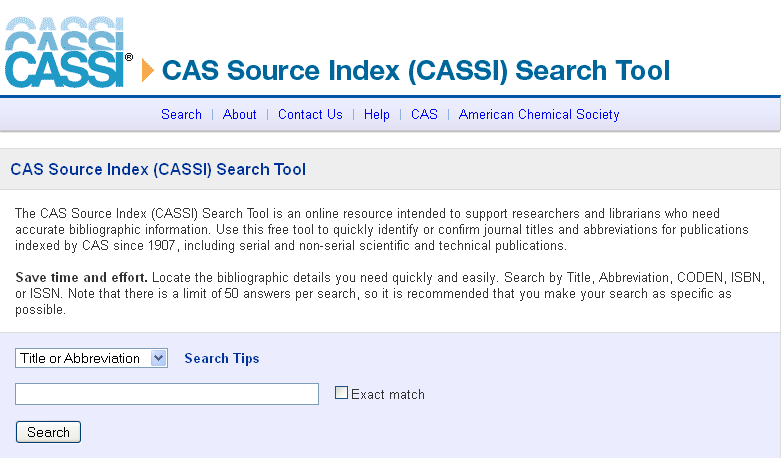
Using the CASSI search tool is straightforward, yet incredibly powerful. Researchers can typically access CASSI through their institutional library subscriptions or directly via the CAS website. The primary utility of the tool lies in its ability to:
- Find Full Journal Titles from Abbreviations: This is perhaps its most common use. If you have an abbreviation from a reference list, simply input it into CASSI, and it will return the full journal title, along with its ISSN, CODEN, and publishing history.
- Discover Standardized Abbreviations: Conversely, if you have a full journal title, CASSI can provide its official, standardized abbreviation, which is critical for preparing bibliographies in ACS Style or other formats that require abbreviated titles.
- Identify CODENs and ISSNs: These unique identifiers are crucial for library systems and interlibrary loan requests, ensuring that the correct publication is requested and received.
- Track Publication History: For journals that have undergone name changes or mergers, CASSI provides a clear history, linking older titles to newer ones.
The CASSI interface is designed for efficiency. You can typically search by:
- Journal Title (full or partial)
- Abbreviation
- ISSN
- CODEN
- Publisher
When inputting a search query, it’s advisable to start with what you know. If you have a partial abbreviation, try that first. For full titles, ensure spelling accuracy. The more precise your input, the more targeted your results will be. It's this very challenge of disambiguation in search that often leads curious individuals searching for, say, "Cassi Davis net worth" to inadvertently discover resources related to chemistry citation and source verification. To delve deeper into this interesting intersection of search intent and academic resources, explore our related article: Why 'Cassi Davis Net Worth' Leads to Chemistry CASSI Guides.
The Interplay of CASSI and ACS Style in Scientific Integrity
The relationship between CASSI and ACS Style is symbiotic. ACS Style, outlined in the "ACS Guide to Scholarly Communication," provides a comprehensive set of guidelines for writing, formatting, and citing chemical literature. A core component of these guidelines is the proper citation of sources, which includes using standardized journal abbreviations.
CASSI acts as the definitive arbiter for these abbreviations. When the ACS Guide recommends abbreviating journal titles, it implicitly refers to the standards maintained within CASSI. This ensures that a bibliography prepared according to ACS Style is not only consistent but also universally understood within the scientific community. Accurate citation, facilitated by CASSI, serves several vital functions:
- Enabling Reproducibility: Researchers must be able to trace every piece of information back to its original source to verify findings and reproduce experiments. Incorrect or ambiguous citations hinder this process.
- Acknowledging Intellectual Contribution: Proper citation gives credit to the original authors and researchers, upholding ethical standards in academic work.
- Building Credibility: A meticulously referenced paper demonstrates the author's diligence and strengthens the credibility of their research.
- Facilitating Literature Discovery: Well-cited papers allow other researchers to easily find relevant foundational and supplementary literature, fostering further scientific advancement.
Best Practices for Using CASSI
To maximize the utility of the CASSI search tool, consider these best practices:
- Be Specific, But Flexible: Start with the most specific information you have (e.g., a CODEN or ISSN). If that yields no results, broaden your search to a partial title or abbreviation.
- Check for Title Changes: If you're looking for an older publication, be aware that journal titles can change over time. CASSI often provides cross-references to previous and subsequent titles.
- Understand Scope: While primarily focused on chemistry, CASSI includes publications from related fields such as materials science, biochemistry, and environmental science.
- Verify Beyond Journals: Remember that CASSI also indexes patents, conference proceedings, and other non-journal serials. This is particularly useful for niche or emerging research areas.
- Cross-Reference with Other Databases: While CASSI is highly authoritative for its domain, cross-referencing information with other reputable bibliographic databases can add another layer of verification, especially for very obscure or international publications.
Conclusion
The CASSI search tool is more than just a list of journal titles; it is a critical component of scientific infrastructure that supports accuracy, integrity, and efficiency in chemical research. By providing a standardized and authoritative index of scientific publications, CASSI empowers researchers to navigate the vast ocean of literature with confidence, ensuring that every citation is precise and every source is verifiable. In a world awash with information, tools like CASSI stand as beacons of reliability, fostering a culture of meticulous scholarship that is essential for the advancement of chemistry and its allied sciences. Embracing CASSI is not merely about following rules; it's about upholding the very standards that define robust scientific inquiry.
